
Research Highlights

Selected projects, papers, and awards from the group — spanning generative modeling, alloy design, polymer physics, and data-driven materials discovery.

Penn State to lead $20M NSF programmable cloud laboratory Featured · Award

Penn State to lead $20M NSF programmable cloud laboratory

PCL Test Bed: LATTICE — Layered and Thin-film Technologies with Intelligent Cloud Experimentation

$20M NSF Programmable Cloud Laboratory · 4-year award

Penn State has been awarded $20 million from the National Science Foundation to lead one of 20 teams nationwide building AI-enabled programmable cloud laboratories, under NSF's new Programmable Cloud Laboratory program (the agency's core contribution to the U.S. government's Genesis Mission). Led by Distinguished Professor Joan Redwing (Materials Science and Engineering), with Stephanie Law (Penn State) and Yufei Ding (UC San Diego) as co-PIs, LATTICE is one of the 20 teams in the nationwide PCL Test Bed network. The broader network includes institutions such as Argonne National Laboratory, Carnegie Mellon, MIT, the University of Pennsylvania, and UC San Diego. The LATTICE project will build a remotely accessible, AI-orchestrated laboratory infrastructure — combining autonomous thin-film deposition, workflow orchestration, real-time monitoring, and LLM-guided experimental design — to dramatically accelerate thin-film materials discovery for semiconductor and quantum technologies.
Teaching AI to design next-generation alloys
Publication

Teaching AI to design next-generation alloys

A five-year publication record on inverse-designing high-entropy alloys, from generative modeling through experimental validation to AI-assisted literature mining.

2026

A body of work on inverse-designing high-entropy and refractory alloys, 2021–2026

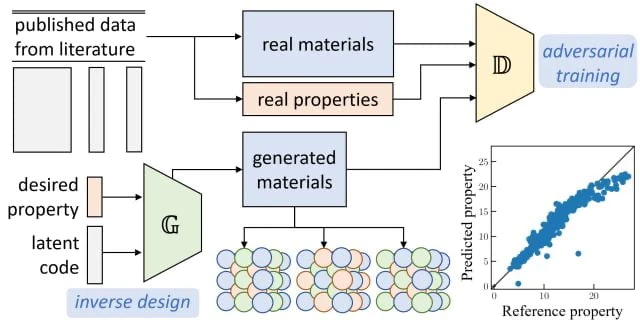
An ARPA-E ULTERA award funded development of a computational and experimental pipeline for designing ultrahigh-temperature refractory alloys, whose properties depend on a compositional space too large to search by hand. The resulting publication record began in 2021 with a paper on generative adversarial network-based inverse design, and has since grown to include a comparison of forward and inverse design methods, a study of alloy representation schemes for surrogate modeling, and experimental validation of inverse-designed alloys — including MoNbTiVWZr, benchmarked against CALPHAD thermodynamic predictions. The group has also released open-source software for compositional space search and, most recently, applied large language models to extract alloy property data directly from the published literature. A sample of these papers is linked below; the group's full publication list is available separately.

NSF funds the next phase of the 2D Crystal Consortium
Award

NSF funds the next phase of the 2D Crystal Consortium

A $4.6M NSF award transitions Penn State's 2D Crystal Consortium user facility toward long-term sustainability, integrating with the new LATTICE cloud lab.

2026 $4.6M

NSF funding supports the Two-Dimensional Crystal Consortium's next chapter

$4.6M NSF · 4-year transition award

The National Science Foundation has awarded $4.6 million over four years to support the next chapter of Penn State's Two-Dimensional Crystal Consortium (2DCC), a Materials Innovation Platform and national user facility housed in the Millennium Science Complex since 2016. Where the 2DCC's 2021 renewal extended it as an NSF-funded user facility, this award funds a transition toward long-term sustainability — including intellectual property development, technology translation, community data infrastructure, and hands-on training for the researchers, national laboratories, and industry partners who rely on it. The facility is also integrating with LATTICE, the newly funded NSF Programmable Cloud Laboratory led by Penn State, which will make 2DCC capabilities remotely accessible and bring AI-orchestrated experimental workflows to thin-film materials discovery.

AI-orchestrated discovery for next-generation 2D materials
Award

AI-orchestrated discovery for next-generation 2D materials

Part of a DOE Genesis Mission project using AI to compress months of 2D-materials synthesis trial-and-error into days.

2026 $300K

AI-Orchestrated Multimodal Platforms for Accelerated Discovery, Scale-Up, and Deployment of 2D Materials

$300K DOE Genesis Mission · Phase I

Our team is part of one of three Penn State-led projects selected for Phase I of the Genesis Mission, a national initiative led by the U.S. Department of Energy to build an integrated AI-powered science discovery platform. Led by Stephanie Law (Materials Science and Engineering), the project combines AI, real-time sensor data, computer simulation, and a large database of past experiments to automatically predict, optimize, and adjust the synthesis of two-dimensional materials used in future electronics and quantum technologies — aiming to cut development time from months to under a week while making manufacturing more reliable, scalable, and industry-ready.

Teaching AI to help students reason through messy, real-world data
Award

Teaching AI to help students reason through messy, real-world data

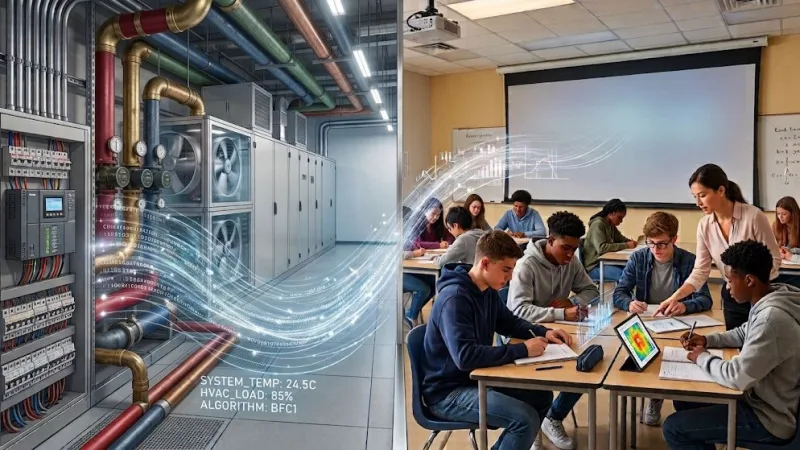
A $1.5M NSF CAMEL grant to teach students to reason through the messy, high-dimensional data engineers face every day.

2026 $1.5M

Phase I CAMEL-CN: Modeling the Messy — Capturing Student Reasoning within High-Dimensional Industrial AI Datasets

$1.5M NSF CAMEL program

Our team has been awarded a $1.5 million grant through the National Science Foundation's CAMEL program (Collaboratory to Advance Mathematics Education and Learning for K-12) to tackle a question we think about constantly as engineers: how do we prepare the next generation to work with data that's actually messy? Most K-12 math and data science curricula teach students on clean, tidy datasets, but that isn't the world they're walking into — real industrial and research data is high-dimensional, noisy, incomplete, and full of the kind of ambiguity engineers navigate every day. The project takes real engineering datasets and builds a framework to translate that complexity into high school math classrooms without stripping out the parts that make it authentic, instrumenting students' actual reasoning process as they work through it — where they get stuck, how they recover, what productive struggle looks like. The goal is to learn how thousands of students reason through genuinely hard, high-dimensional problems, and to give other engineering researchers a way to bring their own real-world data into the classroom.

Training the next generation in sustainable materials design
Award

Training the next generation in sustainable materials design

A $3M NSF traineeship building a graduate certificate in data-driven, circular materials design.

2025 $3M

NRT: Data science-driven sustainability-centered advanced materials processing (Sus-Mat)

$3M NSF Research Traineeship · 5-year program

A $3 million grant from the National Science Foundation's Research Traineeship program will fund a five-year graduate training initiative that integrates data science and artificial intelligence into sustainable materials and process design. Led by Allison Beese (Materials Science and Engineering), with Wesley Reinhart among the co-PIs, the program spans Penn State's College of Earth and Mineral Sciences, College of Engineering, College of the Liberal Arts, and College of Arts and Architecture. Trainees will earn a graduate certificate in Data-Driven Sustainable Design for Circularity in Advanced Materials Processing, learning to evaluate material lifecycles holistically — from sourcing through recycling — with explicit attention to manufacturing processes, public policy, and societal impact. The program will train 50 graduate students through professional development, internships, and cross-college capstone experiences.

Large Language Models can design molecules
Publication

Large Language Models can design molecules

Claude 3 Opus can read, write, and steer molecular structures from plain-language prompts alone.

2024

Large Language Models as Molecular Design Engines

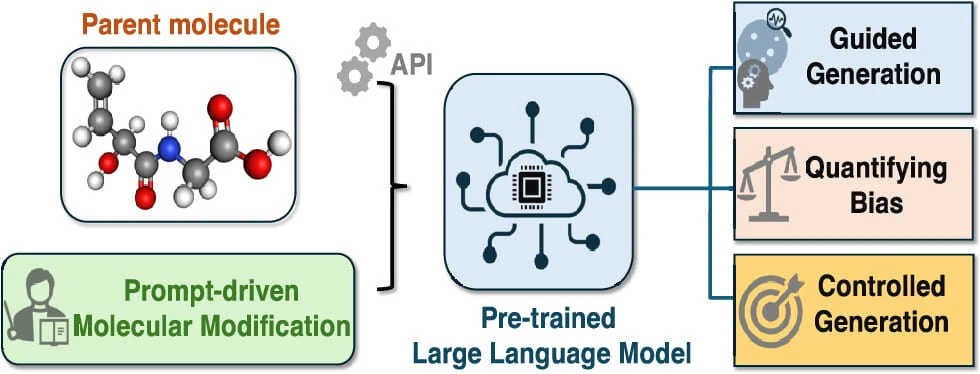
Designing new molecules is crucial for advancing fields like drug discovery, materials science, and energy storage. However, traditional strategies often struggle with molecular design due to requirements such as sufficient data, domain knowledge, model fine-tuning, labeled data, computational resources, and time. To address these challenges, we explored the potential of Large Language Models (LLMs) in molecular design. LLMs, advanced AI systems trained on vast web-based text data, can understand and generate human-like text. Although not explicitly designed for molecular design, we demonstrated that Claude 3 Opus, an advanced LLM, can effectively read, write, and modify molecular structures using simple textual prompts. Our work shows that the LLM performs on par with state-of-the-art molecular design architectures. We systematically evaluated the model's behavior under various prompting conditions, showing that the LLM can perform guided molecular generation and can be readily steered, such as creating molecules with specified levels of similarity to given structures. This work opens the door to many advanced applications of LLMs in chemical modeling and design.

Technical abstract

The design of small molecules is crucial for technological applications ranging from drug discovery to energy storage. Due to the vast design space available to modern synthetic chemistry, the community has increasingly sought to use data-driven and machine learning approaches to navigate this space. Although generative machine learning methods have recently shown potential for computational molecular design, their use is hindered by complex training procedures, and they often fail to generate valid and unique molecules. In this context, pretrained Large Language Models (LLMs) have emerged as potential tools for molecular design, as they appear to be capable of creating and modifying molecules based on simple instructions provided through natural language prompts. In this work, we show that the Claude 3 Opus LLM can read, write, and modify molecules according to prompts, with impressive 97% valid and unique molecules. By quantifying these modifications in a low-dimensional latent space, we systematically evaluate the model's behavior under different prompting conditions. Notably, the model is able to perform guided molecular generation when asked to manipulate the electronic structure of molecules using simple, natural-language prompts. Our findings highlight the potential of LLMs as powerful and versatile molecular design engines.

Inverse-designing self-assembling macromolecules
Award

Inverse-designing self-assembling macromolecules

An NSF award to design monomer sequences that self-assemble into a target structure directly, without trial-and-error simulation.

2024 $608K

Collaborative Research: CDS&E: Inverse Design of Sequence-Defined Macromolecules using Generative Deep Learning

$608K NSF CDS&E · 3-year award

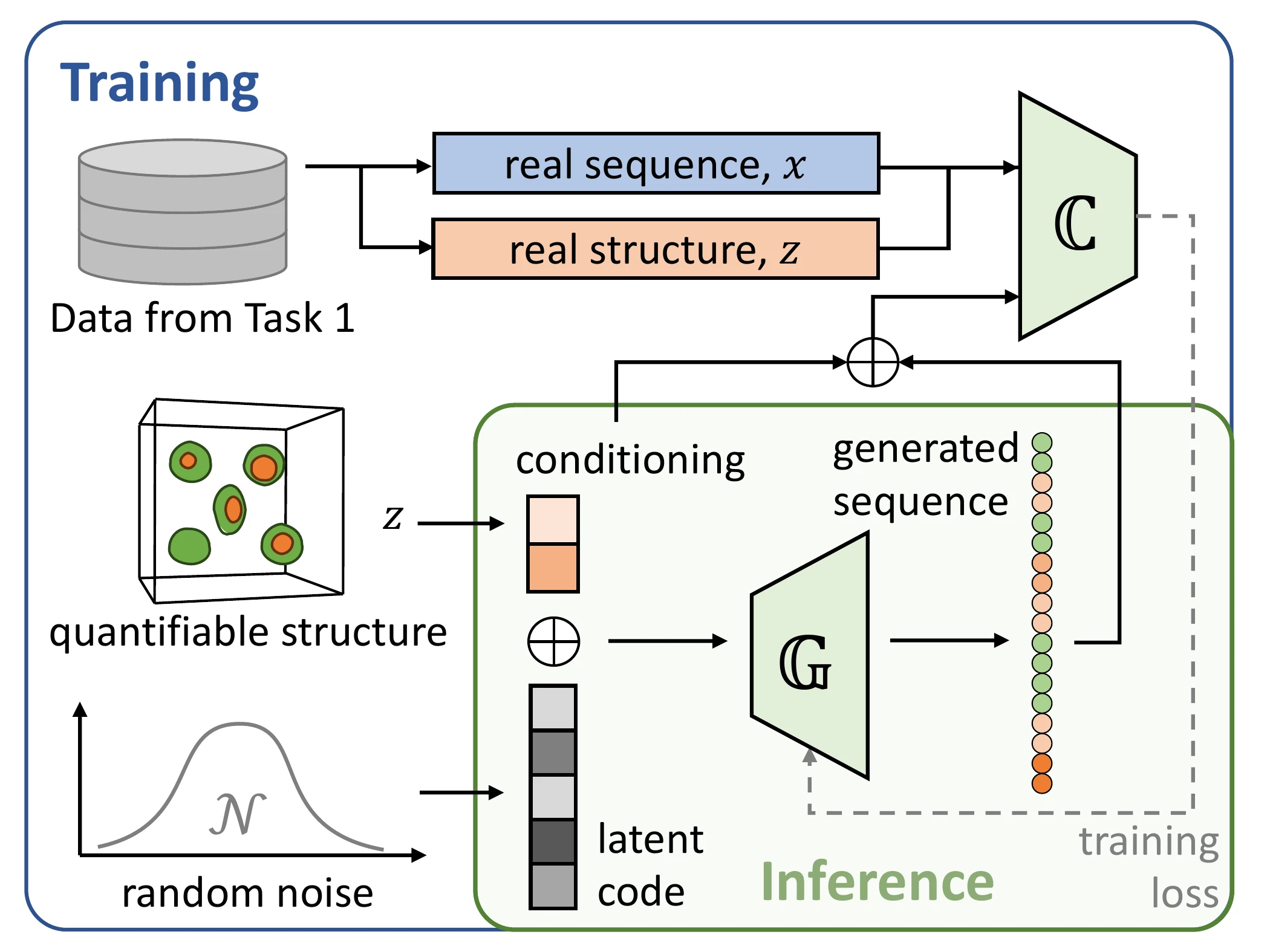
Sequence-defined macromolecules are polymers with a precisely controlled order of monomers along the chain, the same principle that lets DNA and proteins encode structure. Advances in polymer chemistry have made these molecules easy to synthesize, opening a large design space for self-assembled materials such as drug delivery vehicles, antifouling coatings, and filtration membranes. Predicting how a given sequence folds and assembles has been difficult, largely because of how many possible sequences there are to search. With co-PI Antonia Statt (University of Illinois Urbana-Champaign), this project builds a coarse-grained simulation and generative deep learning pipeline that works in the opposite direction: starting from a target structure and inferring the monomer sequence that will produce it. The generative model is designed to be interpretable, so the sequence-structure-property relationships it learns can be understood and reused even without an existing physical explanation. The project benchmarks its inverse design strategy against other data-driven design schemes and supports an annual workshop and online tutorials for training students in data-driven soft materials design.

Designing next-generation polymer electrolytes
Award

Designing next-generation polymer electrolytes

An $11.5M DOE center hunting for the mechanisms behind fast, correlated ion transport in polymer electrolytes.

2022 $11.5M

Fast and Cooperative Ion Transport in Polymer-Based Electrolytes (FaCT)

$11.5M DOE EFRC · 4-year center

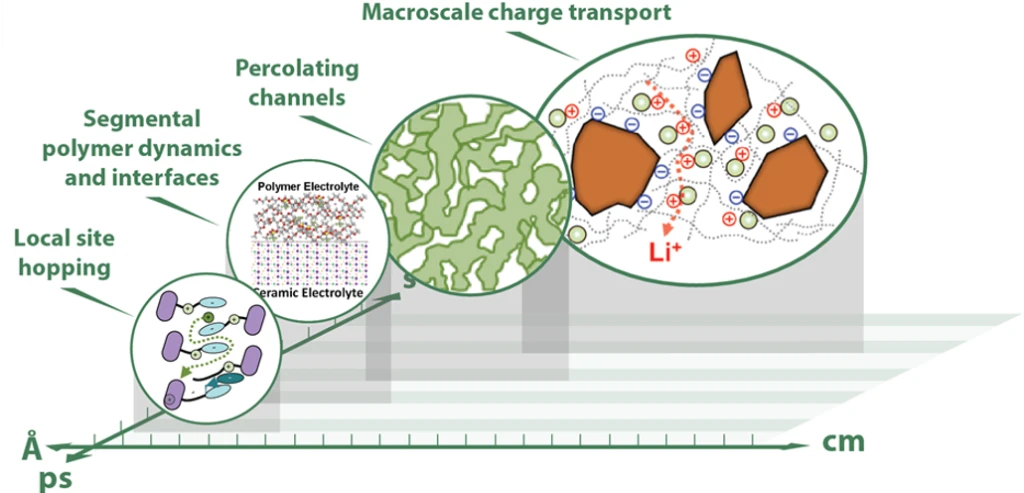
The overarching goal is to understand and control fast, correlated ion and proton transport at multiple length and time scales. The aim is to build a predictive, data-driven mechanistic model of ion transport in polymers and polymer-ceramic composites to enable the targeted design of next-generation energy storage and conversion materials. The award will provide $11.5 million over four years to the new ORNL-led EFRC for Fast and Cooperative Ion Transport in Polymer-Based Electrolytes. DOE awarded more than $400 million toward establishing and continuing 43 EFRCs across the nation.

This proposal has two main thrusts:

THRUST 1 Thrust 1: Unveil the mechanisms driving correlated alkali ion and proton transport in polymers; with the goal of understanding and realizing new mechanisms of superionic conductivity (Li+, Na+, H+) in polymer-based materials
THRUST 2 Thrust 2: Elucidate the microscopic mechanisms controlling collective ion transport along and across polymer–ceramic interfaces, to design modified interfaces with reduced ion diffusion barriers
THRUST 3 Crosscutting will be rational design through computation, theory, and materials informatics, which will leverage fundamental knowledge obtained from the other research activities to enable rational design of fast ion conducting polymer and polymer-ceramic membranes and electrolytes
Using deep learning to understand polymer self-assembly
Publication

Using deep learning to understand polymer self-assembly

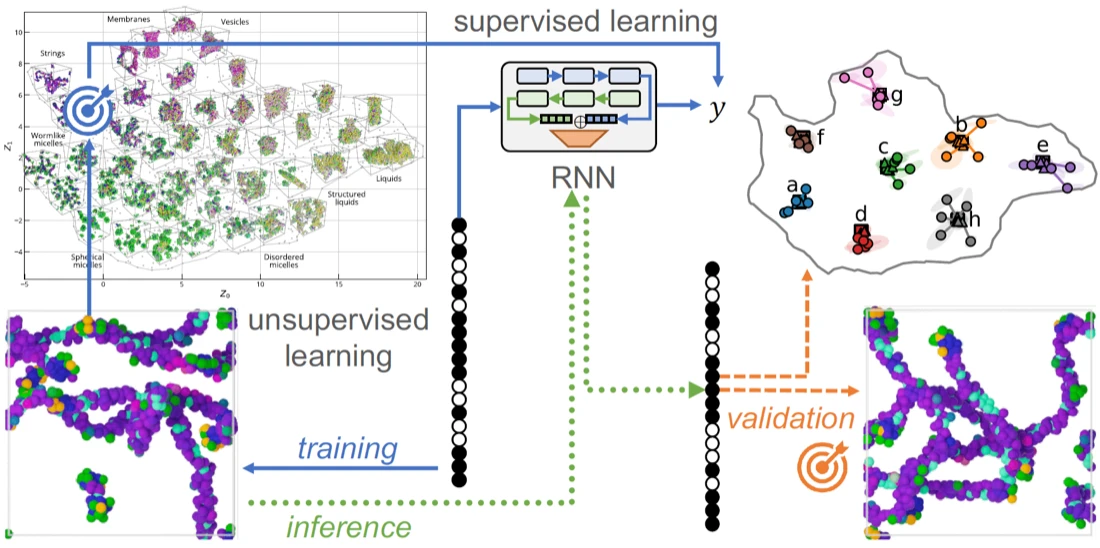
A recurrent neural network predicts how sequence-defined macromolecules self-assemble, and screens for target morphologies.

2022

Predicting aggregate morphology of sequence-defined macromolecules with recurrent neural networks

Self-assembly of dilute sequence-defined macromolecules is a complex phenomenon in which the local arrangement of chemical moieties can lead to the formation of long-range structure. The dependence of this structure on the sequence necessarily implies that a mapping between the two exists, yet it has been difficult to model so far. Predicting the aggregation behavior of these macromolecules is challenging due to the lack of effective order parameters, a vast design space, inherent variability, and high computational costs associated with currently available simulation techniques. Here, we accurately predict the morphology of aggregates self-assembled from sequence-defined macromolecules using supervised machine learning. We find that regression models with implicit representation learning perform significantly better than those based on engineered features such as k-mer counting, and a recurrent-neural-network- based regressor performs the best out of nine model architectures we tested. Furthermore, we demonstrate the high-throughput screening of monomer sequences using the regression model to identify candidates for self-assembly into selected morphologies. Our strategy is shown to successfully identify multiple suitable sequences in every test we performed, so we hope the insights gained here can be extended to other increasingly complex design scenarios in the future, such as the design of sequences under polydispersity and at varying environmental conditions.

Smart cities built with smart materials
Perspective

Smart cities built with smart materials

A Science perspective on how locally-responsive smart materials keep smart cities from drowning in their own sensor data.

2021

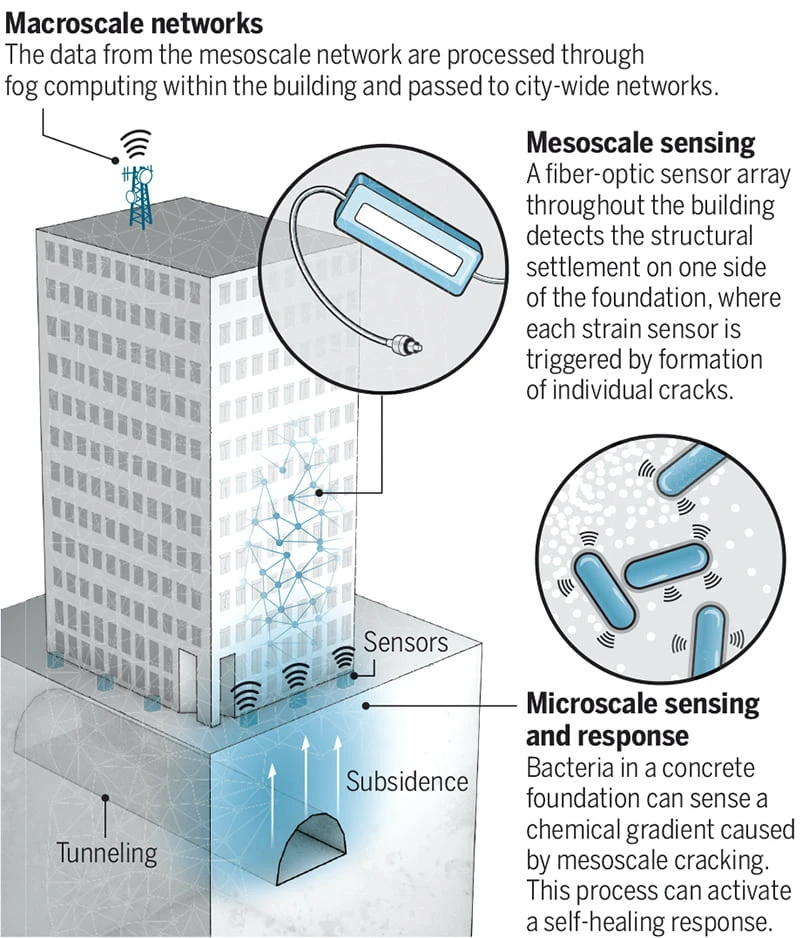
The Smart City Index defines a smart city as "an urban setting that applies technology to enhance the benefits and diminish the shortcomings of urbanization for its citizens." The top-ranked city, Singapore, has addressed urban challenges with information technology since 2014 through its Smart Nation Initiative. The influence of technology is reflected in the city's open platform for sharing energy data, crowd-sourced location data for smart navigation, and even online forums for citizen participation in policy-making. The smart city concept requires the acquisition of massive amounts of data in real time, and large networks of smart devices must spread the burden of communication and processing evenly across the network to prevent information overload at its center. Opportunities to solve this challenge have recently emerged through the development of increasingly "smart materials" that can sense, process, and respond to environmental stimuli without centralized resources.

Equipping engineers with data science
Award

Equipping engineers with data science

Building a transferable curricular framework for infusing data science into engineering education nationwide.

2021

Infusion of data science and computation into engineering curricula

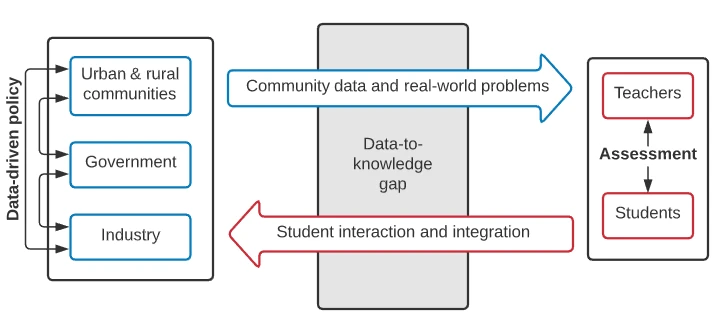
The goal of this project is to develop a curricular framework for data science education and workforce development that is transferable between diverse institutions, so STEM-related programs can plug and play data science lessons with existing curricula without much overhead. These lessons will be created in conjunction with community stakeholders and industry partners to ensure a focus on real-world problem solving and include student organizations in course development to promote flexible learning pathways. The proposed additions to undergraduate STEM education will provide an evidence-based blueprint for best practices in integrating data science with existing engineering curricula. Implementation across multiple engineering departments will result in a significant impact on society through the training of a diverse, globally competitive STEM workforce with high data literacy.

Designing next-generation high-temperature alloys
Award

Designing next-generation high-temperature alloys

A $1.2M ARPA-E award to computationally design and manufacture ultrahigh-temperature refractory metal alloys.

2020 $1.2M

Design and Manufacturing of Ultrahigh-Temperature Refractory Metal Alloys

$1.2M ARPA-E ULTIMATE

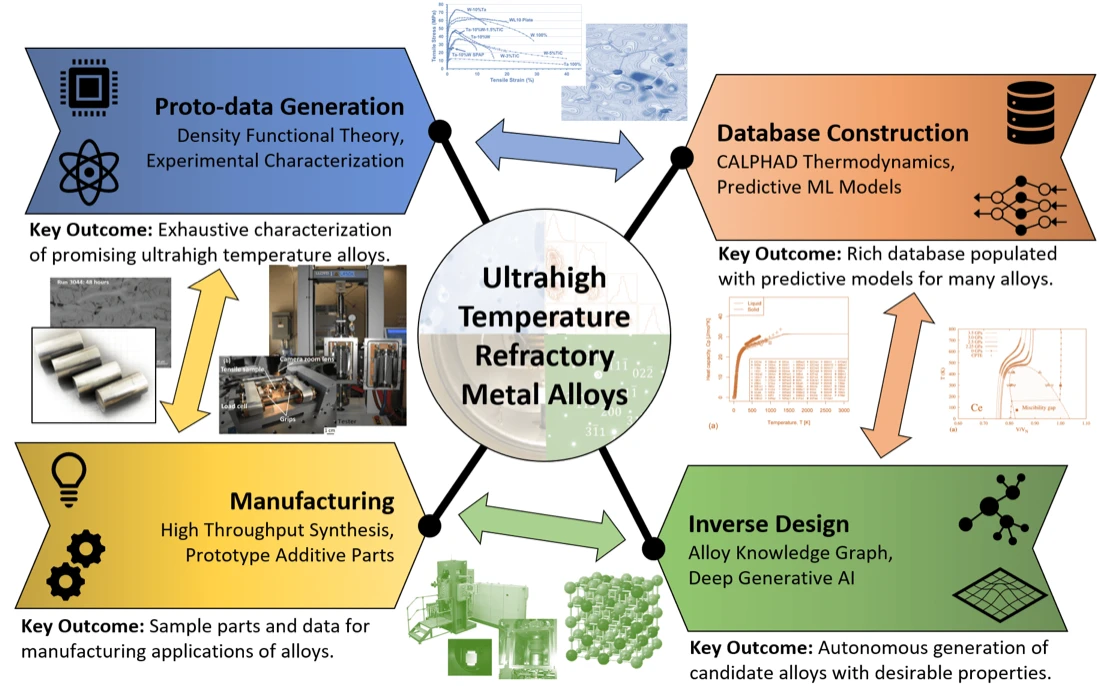
An integrated computational and experimental framework for the design and manufacturing of ultrahigh-temperature refractory alloys may become possible thanks to a $1.2 million grant from the U.S. Department of Energy's Advanced Research Projects Agency-Energy (ARPA-E) awarded to a team of Penn State materials scientists.

The project consists of four major components:

THRUST 1 Computational data generation through high throughput first-principles calculations based on the density functional theory, deep neural networks machine learning models, crystal plasticity finite elements method simulations and high throughput Calculation of Phase Diagrams (CALPHAD) modeling of phase stability
THRUST 2 Inverse design of ultrahigh temperature refractory alloys (ULTERAs) using both computational and experimental data and the strengthening and toughening mechanisms
THRUST 3 Advanced manufacturing techniques utilizing field assisted sintering technology
THRUST 4 Systematic characterization to demonstrate performance in terms of mechanical and thermal properties of the designed materials in collaboration with industry