
Process-informed differentiable build planning of compositionally graded materials
Virtual and Physical Prototyping (2026)
Abstract
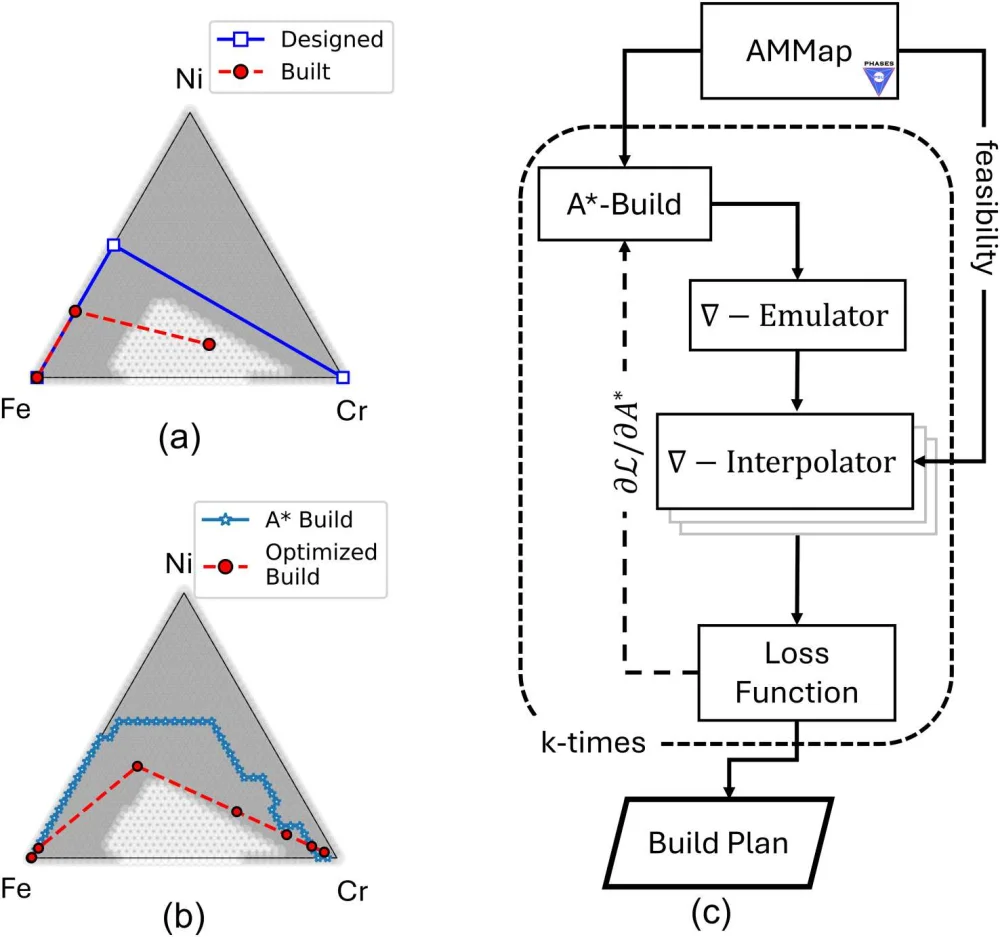
Discrepancies between as-designed and as-built parts remain a major barrier to the additive manufacturing of compositionally graded materials (CGMs), where unintended brittle phases can compromise part integrity. Existing computational methods traverse composition graphs to circumvent deleterious phases but typically neglect dilution, the inevitable interlayer mixing in the melt pool that can shift final compositions into infeasible regions. We introduce an end-to-end differentiable framework that co-optimises the as-designed and as-built path by coupling a physical dilution model with differentiable surrogates for phase feasibility and material properties. The framework supports practical manufacturing constraints, such as limiting active feedstocks and encouraging composition grouping, alongside property objectives including monotonic coefficient of thermal expansion and increased interlayer acoustic contrast as an idealised proxy for ultrasonic non-destructive evaluation. We demonstrate the method on Fe-Ni-Cr ternary builds and use Nash multi-task learning to balance competing objectives without manual weight tuning. We also analyze sensitivity to dilution-ratio uncertainty by optimising over a band of ratios, planning against a layer-wise stochastic scheme, and coupling the ratio to the local composition. Validation is computational and relies on published experimental measurements.