
Accelerating Proton Affinity Prediction with Multi-Fidelity Machine Learning
Digital Discovery (2026)
Abstract
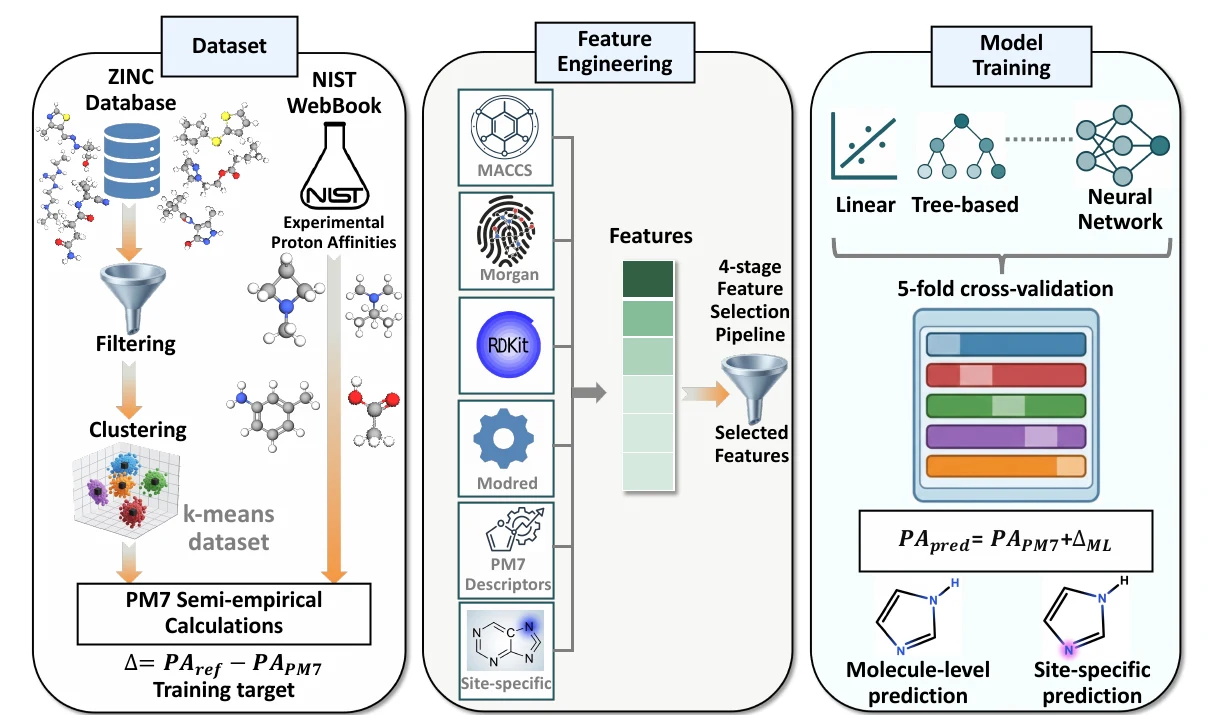
Accurate gas-phase proton affinities (PAs) are essential for designing proton carriers in anhydrous fuel cells, rationalizing acid-base chemistry, and guiding high-throughput molecular screening, yet the expense of high-level quantum-chemical calculations limits their routine application to large libraries. We develop a multi-fidelity ∆-learning framework that learns the systematic correction between fast PM7 semi-empirical calculations and high-fidelity references (specifically, experimental gas-phase PAs from the NIST WebBook and B3LYP/def2-TZVP DFT values) using only PM7 electronic properties and cheminformatics descriptors, without requiring DFT-derived features. On a 1,155-molecule benchmark derived from the NIST WebBook, an ExtraTrees model reduces the PM7 mean absolute error (MAE) from 8.21 to 2.87 kcal/mol (65% reduction), matching the accuracy ceiling set by B3LYP/def2-TZVP against experiment (3.74 kcal/mol), despite using no DFT-derived features. We extend ∆-learning to the more challenging task of site-specific PA prediction on a 251-molecule, 821-site k-means dataset constructed for chemical diversity, reducing the PM7 baseline from 17.96 to 6.85 kcal/mol (62% reduction). Functional group analysis and SHAP interpretation reveal two distinct PM7 failure regimes: systematic underestimation for aromatic nitrogen heterocycles, ethers, and amides due to inadequate treatment of electronic delocalization upon protonation, and systematic overestimation for nitriles and strained ring systems. These patterns provide practical guidelines for model deployment. We demonstrate the framework’s utility in a seven-stage agentic screening pipeline for anhydrous proton carrier discovery. The pipeline combines FAISS similarity search, PM7 + ∆-ML prediction with ensemble uncertainty quantification, large language model-assisted chemical reasoning (Claude Opus 4.6), and multi-objective Pareto optimization to reduce 821,435 pre-filtered ZINC molecules to 30 DFT-validated candidates. Of these, 29 (97%) fall within the target proton-affinity window (210-235 kcal/mol); post-hoc substructure verification confirms that 27 of these satisfy the structural requirements for Grotthuss-type proton transport, with a prospective MAE of 5.59 kcal/mol. Five priority leads are identified, including commercially available 3-amino-1 H -pyrazole and (3-(thiophen-2-yl)-1 H -pyrazol-5-yl)methanol, with DFT-validated proton affinities in the range 226-231 kcal/mol, above the experimental PA of imidazole (225.3 kcal/mol), the benchmark anhydrous proton carrier, and favorable synthetic accessibility scores.