Analyzing the impact of Se concentration during the molecular beam epitaxy deposition of 2D SnSe with atomistic-scale simulations and explainable machine learning
Materials Today Advances (2025)
Abstract
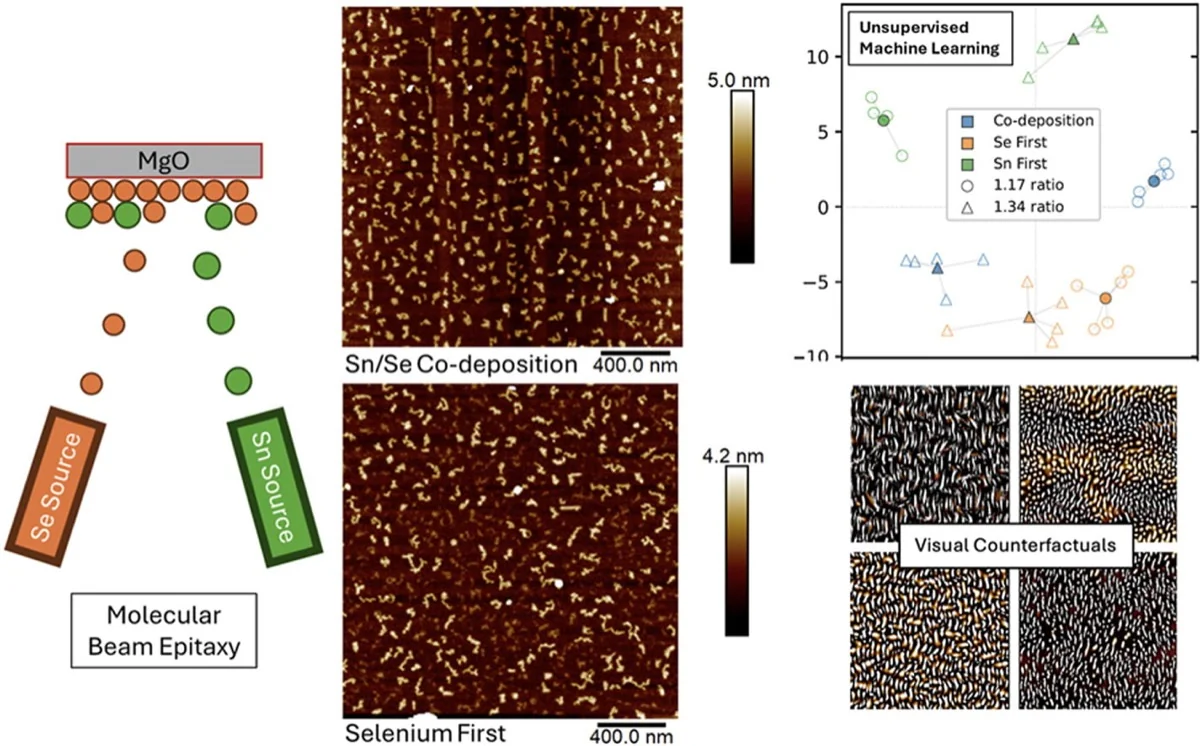
Pushing microelectronics to the atomic scale requires developing routes to deposit highly anisotropic 2D semiconductors like SnSe with atomic-layer control, select crystallographic orientations, and broad lateral coverage. In 2D chalcogenides introducing Se prior to deposition has been shown to promote lateral grain growth, while decreasing the Se flux induces crystallographic misorientation, but the role Se plays in the morphological development of SnSe is not yet clear. This work investigates how increasing the Se:Sn flux ratio and deposition timing (Se-first or co-deposition) during molecular beam epitaxy impacts the SnSe microstructure and orientation. Reflection high-energy electron diffraction (RHEED) confirms that SnSe maintains a [010]SnSe||[100]MgO orientation for all deposition conditions. To track the morphologies back to the critical processing variables, we developed an unsupervised-machine learning (ML) model from the atomic force micrographs (AFM) and RHEED. Generating synthetic visual counterfactuals from the AFM data provides a human-interpretable link between the processing variables and SnSe texture, highlighting how higher Se concentrations produce thinner SnSe grains. Direct AFM image processing shows the 1.34:1 flux ratio reduces grain step height by 36 % to 0.7 nm for the Se-first depositions. However, the grain number density decreases with Se-first for the 1.17 and 1.34 flux ratios by 0 % and 47 %. ReaxFF-based molecular dynamics simulations correlate the difference in grain number density with deposition timing, showing the passivation of the surface oxygen atoms for Se-first depositions leading to reduced nucleation. Ultimately, the combination of ML modeling, atomistic-scale simulations, and experimentation provides the critical insights needed to advance 2D chalcogenide microelectronics.